
Military PCS Car Shipping Guide
Vinmove Team
Author
July 8, 2026
Published
July 8, 2026
Updated
The Strategy of Relocation: Deciphering the PCS Vehicular Conundrum
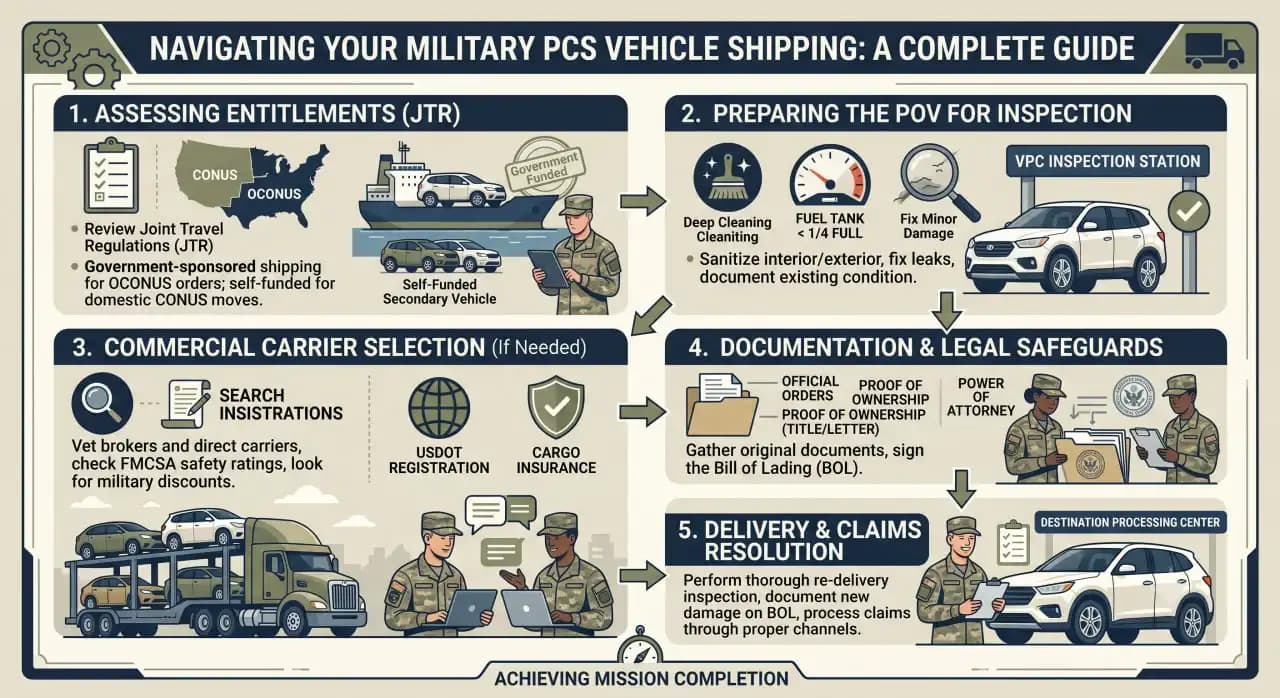
A Permanent Change of Station (PCS) order instigates a whirlwind of logistical maneuvers for military personnel. Among the most complex puzzles is the physical relocation of personal vehicles. The Department of Defense establishes precise parameters for when the government will cover these costs, leaving service members to navigate a dense thicket of regulatory guidelines. Managing this transit effectively demands a calculated approach, moving far beyond simple coordination to ensure operational readiness at the next duty assignment.
Understanding the mechanics of military car shipping ensures that a privately owned vehicle (POV) arrives safely, legally, and without unexpected financial burdens.
Entitlements and Authorized Shipments: The Joint Travel Regulations (JTR)
The foundational blueprint for any military move is the Joint Travel Regulations (JTR). This document dictates your specific vehicular entitlements based on your destination and order parameters.
+-----------------------------------+-----------------------------------+
| CONUS-to-CONUS Moves              | OCONUS Moves (Overseas)           |
+-----------------------------------+-----------------------------------+
| • Generally self-funded transit   | • One POV government-sponsored    |
| • Mileage allowance if driven     | • Subject to strict port limits   |
| • Exceptions require specific dual| • Weight and size restrictions    |
|   military or medical waivers     |   apply per regulatory standards  |
+-----------------------------------+-----------------------------------+
For domestic assignments within the continental United States (CONUS), the government typically expects service members to drive their vehicles, providing a Monetary Allowance in Lieu of Transportation (MALT). Government-funded POV shipping is generally reserved for transoceanic, Outside Continental United States (OCONUS) orders. If a household possesses multiple vehicles, any secondary or tertiary automobiles fall outside government sponsorship, requiring independent, privately funded logistics.
Preparing the POV for Inspection: The Rigor of Turn-In
The vehicle turn-in process at a Vehicle Processing Center (VPC) demands absolute meticulousness. Agriculture and customs inspections are unforgiving, meaning a single speck of soil or an overlooked personal item can cause an immediate rejection.
Pre-Inspection Protocol: The vehicle must undergo deep sanitation, stripping it of all non-permanent modifications, personal effects, and debris to satisfy strict agricultural biosecurity standards.
Mechanically, the vehicle must be in prime operational condition. The fuel tank faces a strict regulatory ceiling: it must be at or below a one-quarter tank capacity to satisfy maritime safety protocols. Furthermore, any pre-existing structural scuffs, windshield chips, or mechanical leaks must be documented with absolute transparency on the Shipping Form (DD Form 1797) to safeguard against transit damage disputes.
Selecting a Commercial Carrier: Private-Sector Solutions
When government entitlements do not cover a secondary vehicle, sourcing a reputable commercial auto transporter becomes necessary. The marketplace features a wide array of brokers and direct carriers, requiring careful vetting to avoid fraudulent operations.
                  [VETTING THE CARRIER]
                            │
         ┌──────────────────┴──────────────────┐
         ▼                                     ▼
   [Credentials]                         [Protections]
   • Active USDOT Registration           • Cargo Insurance Verification
   • Valid MC (Motor Carrier) Number     • Transparent Military Discount
   • Verified FMCSA Safety Rating        • Explicit Claims Processes
Always verify credentials through the Federal Motor Carrier Safety Administration (FMCSA) database. Look for active USDOT and Motor Carrier (MC) numbers. Legitimate maritime and overland haulers frequently provide specialized military discounts as a nod to service, alongside explicit cargo insurance policies that provide comprehensive coverage during transit.
Documentation and Legal Safeguards: Navigating the Paperwork
Securing your assets during a major relocation requires an ironclad paper trail. You must gather a comprehensive folder of original documents before handing over the keys to any transport operator.
-
Official Orders: Multiple copies of your PCS orders must accompany the vehicle transport authorization.
-
Proof of Ownership: The vehicle title, or a formal letter of authorization from the lienholder if the car is financed, is legally mandatory for OCONUS shipping.
-
Power of Attorney: If a spouse or designated agent is managing the turn-in or pick-up, a specific legal Power of Attorney must be executed beforehand.
Carefully review the Bill of Lading (BOL) at both origin and destination. This document serves as your primary legal receipt, detailing the exact physical state of the vehicle before it enters the commercial logistics network.
Delivery and Claims Resolution: Achieving Mission Completion
The final phase of the logistical operation unfolds at the destination processing center or delivery point. Treat the re-delivery inspection with the same focus as an operational debrief. Conduct a thorough walk-around, checking the undercarriage, glass surfaces, and electronic systems for any anomalies that occurred during transit.
If you discover any transit-induced damage, note it immediately on the delivery receipt before signing. For government-sponsored moves, claims must be processed through the Military Claims Office or the designated VPC portal within strict, time-sensitive reporting windows. Documenting the issues with clear photographic evidence ensures a smooth resolution, allowing you to settle into your new station with your vehicle fully operational.
Related Articles
Continue reading with these related posts

Official Announcement: VINMOVE Team Update & New Email Domain
At VINMOVE, we are continuously evolving to serve our clients and logistics partners better.
Cost to Ship a Car From Florida to California (2026)
See 2026 rates to ship a car from Florida to California — open vs. enclosed pricing, transit times, and how to get an accurate quote from Vinmove.
Top 5 Things That Can Delay Your Car Shipment (And How to Handle It)
Handing over the keys to your beloved four-wheeled chariot can feel a bit like sending a kid off to college.