
What Happens If My Car Is Damaged During Shipping?
Vinmove Team
Author
July 8, 2026
Published
July 8, 2026
Updated
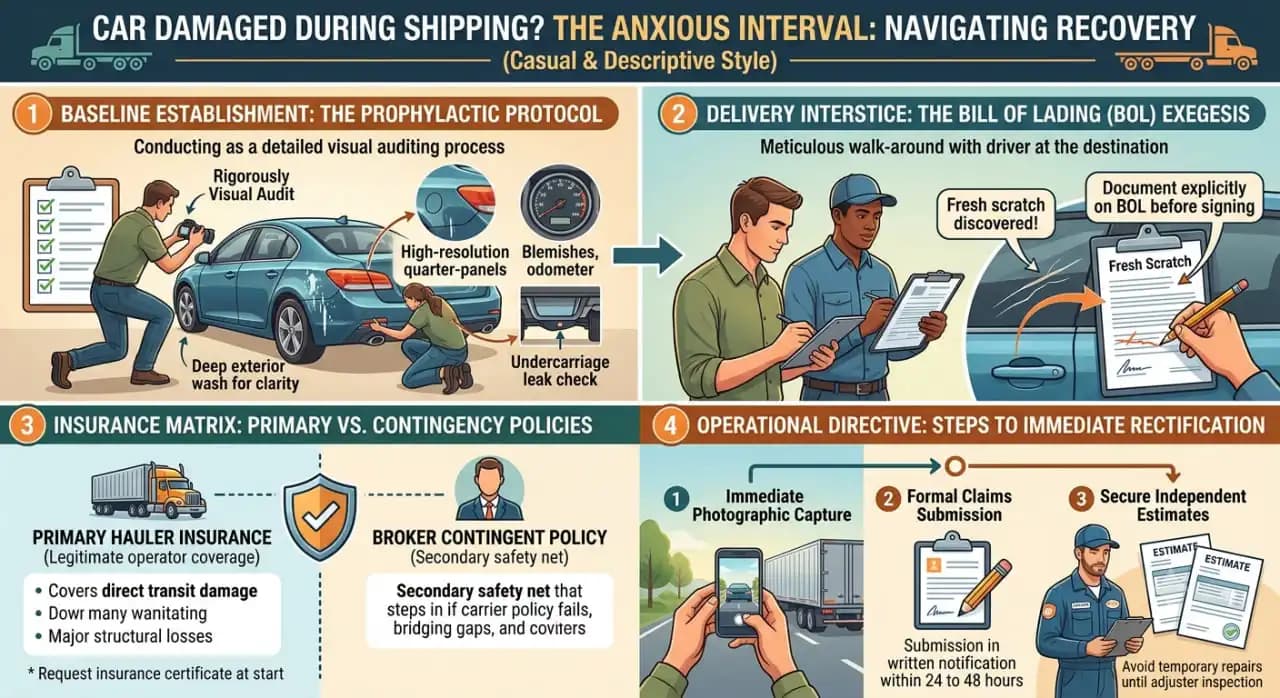
Handing over the keys of a prized vehicle to an auto transport carrier can trigger a distinct sense of vulnerability. Your automobile, a highly complex mechanical asset, enters a vast industrial logistical framework. While the statistical probability of structural or cosmetic compromise is remarkably low, the question remains: what happens if the unthinkable occurs?
Navigating the aftermath of transit damage requires moving past panic. By executing a calculated, step-by-step protocol, you can smoothly manage the recovery process and protect your investment.
The Prophylactic Protocol: Documenting the Baseline At Origin
Securing full compensation for any transit incident begins long before the haulage truck ever shifts into gear. Establishing an undeniable, hyper-detailed baseline of your vehicle’s physical state is your primary shield. This requires a rigorous visual auditing process.
+-----------------------------------+-----------------------------------+
| Pre-Transit Checklist             | Photographic Targets              |
+-----------------------------------+-----------------------------------+
| • Deep exterior wash for clarity  | • High-resolution quarter-panels  |
| • Comprehensive interior audit    | • Close-ups of existing blemishes |
| • Undercarriage fluid leak check  | • Odometer and dashboard cluster  |
+-----------------------------------+-----------------------------------+
Before the carrier arrives, give your vehicle a thorough deep wash to ensure any existing blemishes are completely visible. Next, take high-resolution photographs from every conceivable angle, capturing the quarter-panels, bumpers, glass, and roof under clear, direct lighting. This comprehensive digital record serves as irrefutable proof, making it impossible for an insurance adjuster to claim that fresh transit damage was actually a pre-existing condition.
The Crucial Interstice: The Bill of Lading (BOL) Exegesis
The Bill of Lading (BOL) is the most critical document in the entire auto shipping ecosystem. It acts simultaneously as a legal receipt, a binding contract, and an official condition report. When the driver drops off your vehicle, you must slow down and treat the inspection with absolute focus.
Legal Reality: Signing the Bill of Lading without explicitly noting new damage completely waives your right to a smooth insurance claim, legally declaring that the vehicle was delivered in perfect condition.
Conduct a meticulous walk-around with the delivery driver, comparing the vehicle's current state directly against the original origin report. If you discover a fresh scratch, an unlisted dent, or structural misalignment, document it explicitly on the BOL before adding your signature. Use precise terminology to describe the issue, and ensure the driver signs off on your observations to lock in your claim's validity.
The Insurance Matrix: Primary Carriers vs. Broker Contingencies
When damage is officially noted on the BOL, the financial recovery phase begins. Legitimate auto transport operators are legally mandated to carry substantial cargo insurance policies. This primary coverage is designed to handle transit-induced mechanical failures or cosmetic damage.
                  [THE COVERAGE HIERARCHY]
                             │
         ┌───────────────────┴───────────────────┐
         ▼                                       ▼
   [Primary Hauler Insurance]            [Broker Contingent Policy]
   • Covers direct transit damage        • Acts as a secondary safety net
   • Handles major structural losses     • Steps in if carrier policy fails
   • Subject to carrier deductibles      • Bridges legal liability gaps
If you booked your move through a logistics broker, they typically maintain a secondary, contingent cargo insurance policy. This steps in as a safety net if the primary hauler's insurance coverage lapses or faces legal hurdles. It is critical to request the carrier’s official insurance certificate at the start of your move, ensuring you know exactly who to contact if you need to file a formal claim.
The Operational Directive: Steps to Immediate Rectification
If you find yourself dealing with a damaged vehicle, executing a swift, organized response is essential. Following a structured sequence prevents administrative delays and keeps your claim on the fast track to resolution.
-
Immediate Photographic Capture: Take clear, high-resolution photos of the new damage right at the delivery point, keeping the transport trailer visible in the background if possible.
-
Formal Claims Submission: Submit a written notification of your intent to file a claim to both the carrier and the broker within 24 to 48 hours of delivery.
-
Secure Independent Estimates: Obtain two independent repair estimates from certified, manufacturer-approved collision repair centers to verify the true cost of restoration.
Avoid making any temporary repairs or altering the damaged areas until an official insurance claims adjuster has physically inspected the vehicle. Keeping your documentation organized ensures a smooth process, turning a stressful situation into a manageable, fully compensated repair.
Related Articles
Continue reading with these related posts

Official Announcement: VINMOVE Team Update & New Email Domain
At VINMOVE, we are continuously evolving to serve our clients and logistics partners better.
Cost to Ship a Car From Florida to California (2026)
See 2026 rates to ship a car from Florida to California — open vs. enclosed pricing, transit times, and how to get an accurate quote from Vinmove.
Top 5 Things That Can Delay Your Car Shipment (And How to Handle It)
Handing over the keys to your beloved four-wheeled chariot can feel a bit like sending a kid off to college.